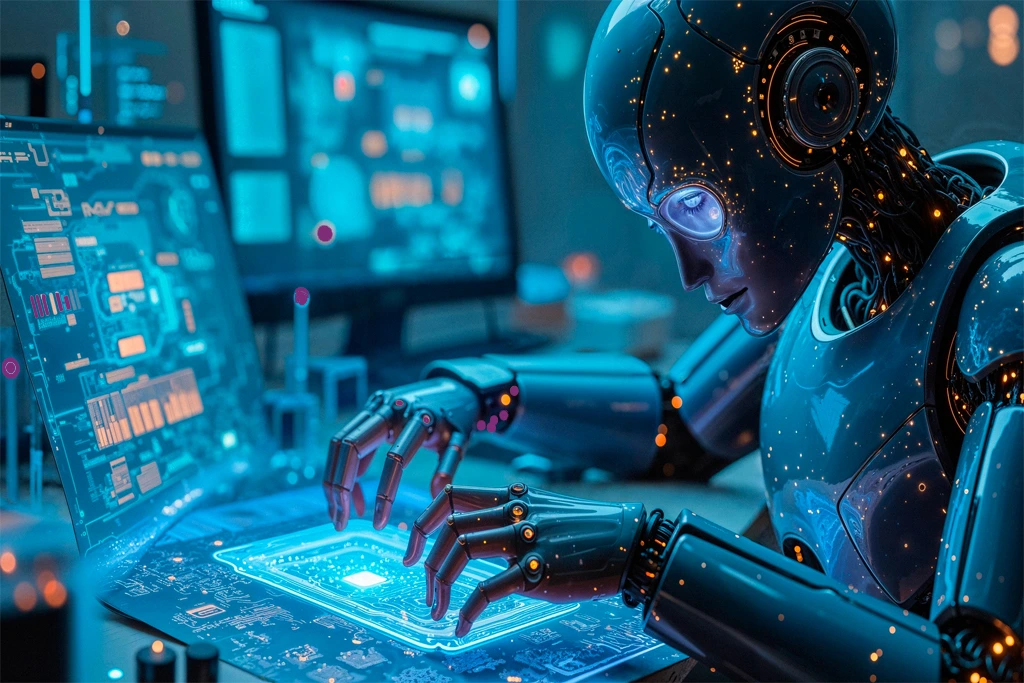
Artificial intelligence (AI) is fast revolutionizing businesses worldwide and software development is not an exception. Software engineering is an adversary that has traditionally been strictly based on human ingenuity, but is being complemented—and occasionally even transformed—by AI technologies. Artificial Intelligence is revolutionizing the entire process from creating code to testing, deploying and maintaining it. It is not simply an automation transition but a transition to making more intelligent, efficient and accessible development ecosystems.
AI-Powered Code Generation
The ability of intelligent code generation is one of the most evident effects of AI on the software development field. Programs such as GitHub Copilot, which are driven by OpenAI,s Codex, may instantly fill in lines of code, propose whole functions, or even create boilerplate code based on the natural language instructions.
This does not mean that Artificial Architecture is replacing the development company. Instead, it performs as an assistant- it hastens boring work, minimizing syntax errors and enabling engineers to work on complex issues as opposed to writing the same function again and again. The result is more productivity and a reduced development cycle.
Smarter Debugging and Error Handling
Debugging has been a very time consuming process of software development. I am altering that. Machine learning models, trained on large sets of data, are now able to find bugs, offer fix suggestions and even indicate areas that bugs may occur in the future based on patterns.
Such tools as DeepCode and Snyk apply AI to examining the code to detect vulnerabilities, logic errors, and inefficient practices. The systems assist in the preservation of code quality and security, something that is of prime concern in the current world that depends on software.
Automated Testing and QA
The quality assurance (QA) phase is another area to be changed by I. When using normal testing processes, detailed test descriptions have to be prepared; this takes a long time and may also be incomplete. Machine learning algorithms can be used for pre-generation test cases, user simulation, and edge case detection that may otherwise be missed in manual testing.
For example, Testim and Functionize platforms use machine learning to develop adaptive tests adapted to the test conditions that grow with the application thereby increasing coverage and reducing maintenance time of tests. It is released in a more stable form, increasing its speed further
AI-Powered CI/CD Optimization
The heart of the modern software development is continuous integration and continuous deployment (CI/CD) pipelines. I is adding significant efficiency to these processes by predicting build failures, optimizing resource utilization and provisioning and scaling application-based infrastructure automatically.
– Things that AIs can do to maintain the performance of a system are: access system logs, reasoning out suspicious activities, and be able to notify teams of an imposing trouble before it affects end-users. Certain systems are able to auto-heal themselves by restarting applications or shifting resource endpoints- resulting in increased efficiency and resilience of software systems.
Enhanced Collaboration and Documentation
I is also smoothening the collaboration among developers Natural language processing (NLP) can be used to create in-time documentation as well as summary of pull requests or translation of comments in different languages or technical depths.
This is particularly valuable where there is a large, distributed team, where communication is especially key. AI can be used to fill knowledge deficits and to have all the persons involved (developers, testers, managers, and clients) running on a common track.
Democratization of Development
Probably one of the most significant changes AI will bring with it is a further reduction in the barrier to entry of non-developers. ChatGPT and no-code/low-code platforms enabled by AI allow many more people to construct applications, automate processes, and create digital tools with fewer coding skills than ever before.
This democratization increases innovation beyond the sphere of developers, allowing business professionals, educators and creators to create their own solutions to their problems.
The Future of AI in Software Development
The application of AI in software development will increase further as the technology continues to develop. We will have smarter development environments, completely automated test suites and software that will be able to predict and generate new software architectures as necessary.
Nevertheless, human creativity, critical thinking, and ethical control, will not be substituted. The collaboration between developers and AI will yield the best solutions- where robots do the hard work, and humans offer guidance and insights as well as creativity.